
What are different states of matter?

This question may sound easy or silly but lets count them..
- Solid
- Liquid
- Gas
- Plasma
- Bose-Einstein Condensate
- Supercritical fluid
- Fermionic Matter
- Rydberg Polaron
- Color-Glass Condensate
- Degenerate Matter
- Photonic Matter
- String net liquid
- Dropleton
- Jahn Teller Metal
- Time crystals
- Quantum Spin Hall
- Super Fluid
- Super Conductivity
- Super Solid
- Fermionic Materials
- Quark Gluon Plasma
- Excitonium
And the list goes on and on!! Scientists are working and discovering new states of matter that exists under certain conditions. Let’s discuss some of them
Solid
A solid is a state of matter with a defined shape and volume. Atoms, ions and molecules in a solid shell close together and can form crystals.

Liquid
A liquid is a state of matter with a defined volume but no defined shape. In other words, liquids take the shape of their container. Particles in a liquid have more energy than in a solid, so they are further apart and less organized (more random).
Gas
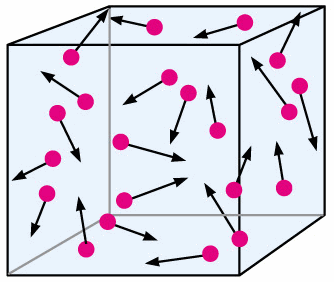
A gas is a state of matter without a defined volume or defined shape. Like a liquid, a gas has the shape of a container. Unlike a liquid, a gas easily expands or contracts to fill the entire volume of a container. Particles in a gas have more energy than in solids or liquids. They tend to be further apart and more random than in a liquid.
Plasma
Plasma is a state of matter similar to a gas, except that all particles carry an electrical charge. Plasma also tends to exist at very low pressure, so the particles are even further apart than in a gas. Plasma can consist of ions, electrons or protons. Examples of plasma include lightning, the aurora borealis, the Sun, and the inside of a neon sign.

Bose-Einstein Condensate
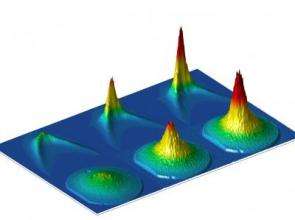
In Bose-Einstein condensate, atoms and ions forestall behaving as separate particles and crumble into a single quantum state that may be described the usage of a single wavefunction. This nation of remember changed into demonstrated experimentally in 1995 by Eric Cornell and Carl Wieman. Bose-Einstein condensate is “colder” than an normal solid and might shape very near absolute zero.
Supercritical fluid
A superfluid is a second liquid country formed by means of a few forms of matter. A superfluid displays zero viscosity. Superfluidity changed into found for helium in 1937. because it could drift without friction, superfluid helium climbed the partitions of its box and dripped over the perimeters. Like Bose-Einstein condensate, superfluidity takes place near absolute zero.

Fermionic Matter
A fermionic condensate is a kingdom of count number just like a Bose-Einstein condensate, except it includes fermions, along with quarks and leptons. commonly, the Pauli exclusion precept forbids fermions from entering the identical quantum country. In a fermionic condensate, a pair of fermions behaves as a boson, permitting more than one pairs to go into the same quantum nation.

Rydberg Polaron
Rydberg matter is a form of plasma formed while excited ions condense.
Color-Glass Condensate
Color-glass condensate is a nation of count proposed to exist whilst atomic nuclei journey near the velocity of liquid. because of their pace, the nucleus seems compressed alongside its course of movement. This causes the gluons of the nucleus to seem as a form of wall or vicinity of multiplied density.

Degenerate Matter
Degenerate count number is a tremendously dense nation of fermionic count number wherein the Pauli exclusion principle exerts significant stress that’s typically modelled as a perfect Fermi gas, an ensemble of non-interacting fermions.
Photonic Matter
Photonic molecules are a theoretical herbal form of matter which also can be made artificially in which photons bind together to form molecules. They were first anticipated in 2007. Photonic molecules are fashioned while massless photons engage with every different so strongly that they act as though they’ve mass.. which also says that even light posses some mass!!
Quark Gluon Plasma
Quarks and gluons are the constructing blocks of protons and neutrons, which in turn are the building blocks of atomic nuclei. Scientists’ current expertise is that quarks and gluons are indivisible—they can not be damaged down into smaller components. they’re the handiest fundamental debris to have something known as coloration-price. due to this, quarks and gluons are sure inside composite particles. The handiest way to split these particles is to create a kingdom of matter called quark-gluon plasma. in this plasma, the density and temperature are so excessive that protons and neutrons soften.


Time crystals
Time crystals are most of the many atypical capabilities of quantum physics. In normal crystals like ice, quartz or diamond, atoms are aligned in a particular physical position — a tiny effect that leads to their distinct normal shapes at larger scales.
however the debris in a time crystal exist in one among two unique low-electricity states relying on simply whilst you observe them — that is, their function in time. That consequences in a ordinary oscillation that keeps forever, a real type of perpetual movement.
however, such perpetual movement only in reality exists all the time in best time crystals that haven’t been fixed into one country or the opposite.

Dropleton
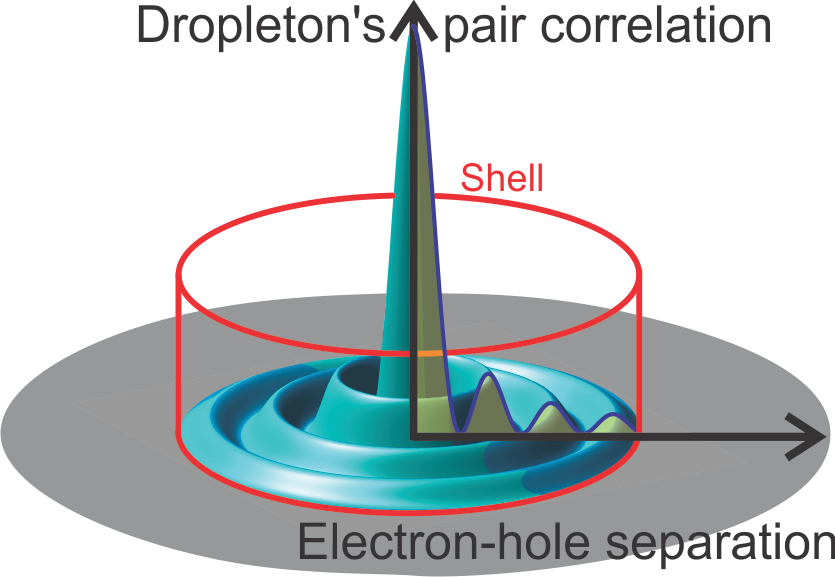
The dropleton is a set of electrons and “holes” (places wherein electrons are lacking) internal a semiconductor, and it has handy properties for analyzing quantum mechanics. the new entity is named a quasiparticle because it is not an fundamental particle, like the quarks and electrons that make up atoms. Like other quasiparticles, the dropleton—the primary quasiparticle located to act like a liquid—can exist handiest interior strong materials.
String net liquid
In a string-internet liquid, atoms have reputedly risky association, like a liquid, but are nonetheless steady in general sample, like a strong. when in a ordinary solid country, the atoms of count align themselves in a grid sample, so that the spin of any electron is the other of the spin of all electrons touching it. however in a string-internet liquid, atoms are organized in a few pattern that calls for some electrons to have buddies with the equal spin. This gives rise to curious homes, in addition to supporting some uncommon proposals about the essential situations of the universe itself.
Jahn Teller Metal
It’s miles used in chemistry to describe how at low pressures, the geometric association of molecules and ions in an electronic kingdom can come to be distorted, this new nation of count number allows scientists to convert an insulator – which cannot conduct energy – right into a conductor via without a doubt making use of pressure. And it is this transition segment among insulator and conductor that, until now, scientists have by no means seen earlier than, and suggestions on the possibility of remodeling insulating substances into brilliant-precious superconducting substances. And this buckyball crystalline structure seems which will do it at a surprisingly high TC.

Excitonium
Excitonium is a condensate – it well – known shows macroscopic quantum phenomena, like a superconductor, or superfluid, or insulating digital crystal. It’s made from excitons, debris which might be shaped in a completely abnormal quantum mechanical pairing, namely that of an escaped electron and the hole it left at the back of.
It defies reason, however it seems that when an electron, seated at the brink of a crowded-with-electrons valence band in a semiconductor, receives excited and jumps over the power hole to the otherwise empty conduction band, it leaves in the back of a “hole” in the valence band. That hollow behaves as although it had been a particle with nice charge, and it draws the escaped electron. when the escaped electron with its terrible price, pairs up with the hollow, the 2 remarkably shape a composite particle, a boson – an exciton.
States of matter describe the properties that matter exhibits. Basically, the state of matter depends on how much energy its particles have.
We can change the energy of matter by changing its temperature or pressure, which causes matter to transition from one state to another. But when matter changes state, its identity remains the same. So, if you take ice, melt it, and then boil it, it changes its state, but it’s always water.
 Peculiar deeds.com